My son, a horror enthusiast
The youngest of my three sons, the six year old, loves horror stories. Naturally we don’t let him watch any kind of horror movies or play horror games – he only plays Little Big Planet with great enthusiasm, and it’s fine – I think that game is really good for him because it allows him to build his own levels. He is a creator in his own little world, and as a writer who builds his own worlds with words, I like it. However, zombies are nowadays not only a part of the horror genre but also a part of children’s culture and thus part of their collective mind, like witches, trolls and fairies have been for centuries. There’s nothing wrong in that – kids need something to be scared of, so beating that scary figure helps them to overcome their fears.
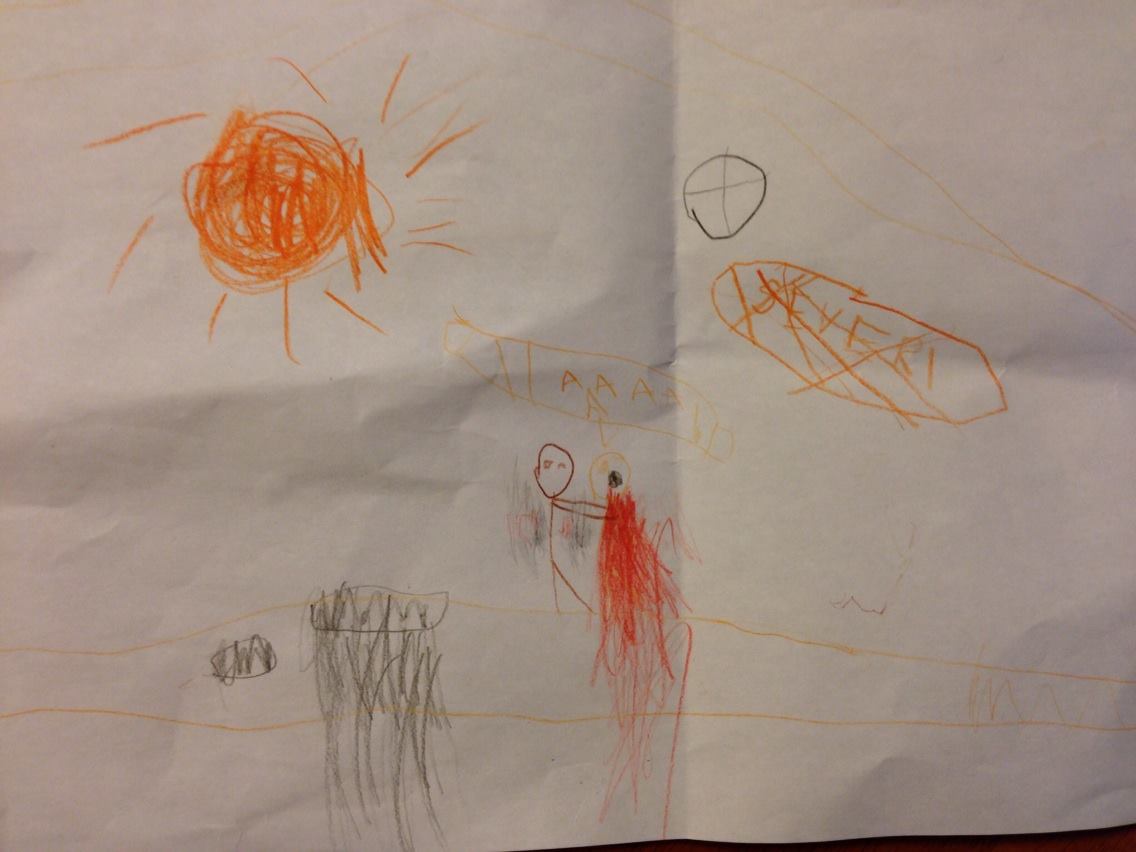
Not so surprisingly, my six year old wishes to hear horror stories for his bedtime stories. So, last night I told him a stupid story about a boy and his pet cow who died and turned into a zombie cow. In the end the boy shot the zombie cow with his big brother’s vaporizer gun. (I admit: the story should and could have been much better, considering that I am a writer…) And today he brought home a drawing he had made in preschool.
It looks like this:
As a kid I had terrible nightmares about vampires and living dead, really dark and scary dreams, but my son’s dreams are not scary, according to him. He doesn’t have nightmares, he actually thinks zombies and ghosts are fun. So, if he is lucky enough, he won’t be a writer when he grows up. To be a writer, you have to be more or less messed up, and so far, despite the zombies, that boy seems to be quite sane
.
The Rabbit Back Literature Society in Waterstones book club!
I was told some time ago that my first translated novel has been selected for Waterstones autumn 2014 book club (and I was also told that I must not talk about it), but now there is an article in The Guardian about translated literature that reveals it. So, there’s another thing for me to be happy about.
Finland is a land of great and diverse literature, and during last years Finnish writers have found a lot of new readers from abroad. It is great because books don’t sell that well in here. Our population is not more that 5,5 million and people have started to read – and buy – books less than they used to. Beside that, practically half of the Finnish people are published writers and we haven’t time enought to read each other’s books… So, conquering the world is the only option for us writers now because we really need new readers for our literature.
An interview
In case you are interested, here’s the TQR-interview of me, made by Steven Hansen few months ago.
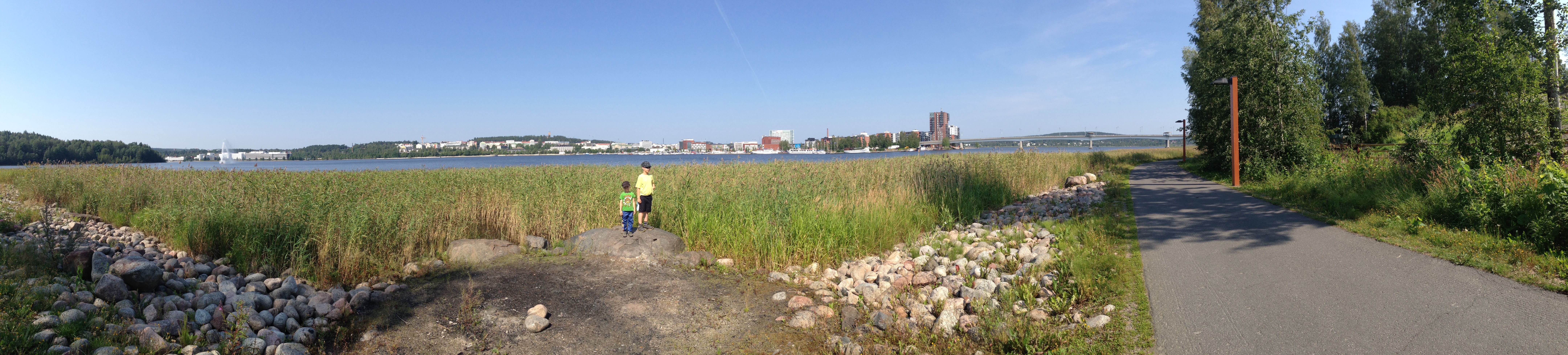
It has been a hot July in Finland and August seems to be even hotter, which is great because quite soon it’ll get dark and cold – as they say in Game of Thrones, winter is coming, and if I may say, our Finnish winters are much worse than winters in GoT, even our zombies are nastier (because in Finland, even zombies have to pay high taxes). But so far it’s warm and sunny in here, the dark wings of winter haven’t darkened our sun and minds yet. I have three sweet days of my vacation left before the schools start (and I have to confront pupils who of course have such a great hunger to learn about literature and Finnish language) and I’m gonna spend that time with my young sons – for example today we took a long walk aroung the Jyväsjärvi lake and crossed two bridges, enjoying the rapidly dwindling summer and those melting ice creams I bought after we crossed the second bridge (which was much further from our starting point than we thought).
I wonder: at what age are we too old to hear the absent-minded songs of the August butterflies?
Words Without Borders: Letter to Lethe
The August 2014 issue of Words Without Borders presents some pieces of Finnish literature, including my short story Letter to Lethe that won the Atorox Award in 2012.
Literature seriously harms you
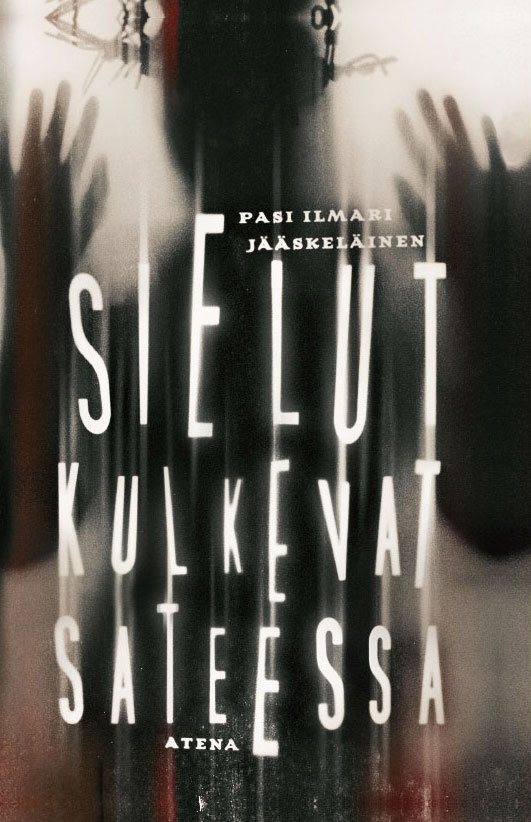
About my latest novel: Souls Walk in the Rain
There are some horror elements in my debut novel The Rabbit Back Literature Society, along with all the other different genre elements it contains (it’s also a detective story, a ghost story and a love story, just to mention a few). Horror elements are there also in my second novel (The Cinematic Life: A Novel, in Finnish: Harjukaupungin salakäytävät) which has not been translated yet, although it is more a love story than anything else – a weird one, of course. But this third novel of mine, Souls Walk in the Rain (it was published in 2013 and hasn’t yet been translated), oh yeah, it is a lovecraftian horror story. And a fantasy story. And a thriller. And a love story. And also my serious attempt to study the very essence of life, death and religion, which of course are the most important themes of all philosophy and art.
I quote Bookthirsty who explains the main premises of the novel in her blog:
Overworked and underpaid Judit leaves her uneventful life and husband for a nursing job with an international organization in Helsinki. Her boss and best friend Martta, mother of her beloved eight year old godson Mauri, has been with the company for many years and explains that the pay and perks are so good because employees are expected to go the extra mile. Nurses are expected to not only take care of the patients’ physical needs, but also that of their souls, something that agnostic Judit has trouble with. She used to believe wholeheartedly as a small child, but hasn’t for years, for reasons which slowly come to light.
Mysterious warnings are sent to her phone in this summer of never-ending rain (the rain never stops in this book, it is even more overwhelming than the snow in The Rabbit Back Literature Society) and for some odd reason she is called upon to treat the so-called ‘king of atheists’, internationally known and controversial, but oh-so-charming Leo Moreau.
This international organization, a big home health care company called F-Remedium, has a device with which it’s possible to revive one’s soul. It’s an important part of the company policies that human souls is an organ that needs to be monitored and treated, not different from all the other organs like heart, lungs or liver. The device they use is called a Persinger device – which actually isn’t just fiction but a real thing: it’s better known as a ”God Helmet”:
The ”God Helmet” refers to an experimental apparatus originally called the ”Koren helmet” after its inventor Stanley Koren. It was developed by Koren and neuroscientist Michael Persinger to study creativity and the effects of subtle stimulation of the temporal lobes. Reports by participants of a ”sensed presence” while wearing the God helmet brought public attention and resulted in several TV documentaries. The device has been used in Persinger’s research in the field of neurotheology, the study of the neural correlates of religion and spirituality. The apparatus, placed on the head of an experimental subject, generates very weak fluctuating magnetic fields, that Persinger refers to as ”complex.” These fields are approximately as strong as those generated by a land line telephone handset or an ordinary hair dryer, but far weaker than that of an ordinary refrigerator magnet and approximately a million times weaker than transcranial magnetic stimulation.
Persinger reports that many subjects have reported ”mystical experiences and altered states”while wearing the God Helmet.
Nurse Judit is given an important mission by her best friend and new boss Martta: Judit’s godson is dying, and as his godmother she is obligated to make him believe in God – boy’s mother Martta is a Christian fundamentalist and everything else but happy about the fact that her terminally ill son is an atheist. Judit is an agnosticist and somewhat reluctant to do so, but eventually she has no choice but try to convince the boy about the existence of God in order to give the dying boy at least some hope.
Later Martta learns that Leo Moreau, the king of atheists, is rumoured to have some kind of evidence about the existence of God in his possession. Of course she sends Judit to investigate the rumour and spy Moreau. And so her great adventure to the core of the secret truth about our universe begins…
Like all the other stories I have ever written, Souls Walk in the Rain is inspired by a dream I once had. Or actually by two dreams. The first one was about a trip to the space. Very surrealistic, a little bit scary – and fascinating enough to haunt me for years until I finally started to spin a story around it. The second dream – which I have had quite often – is about climbing endless stairs.
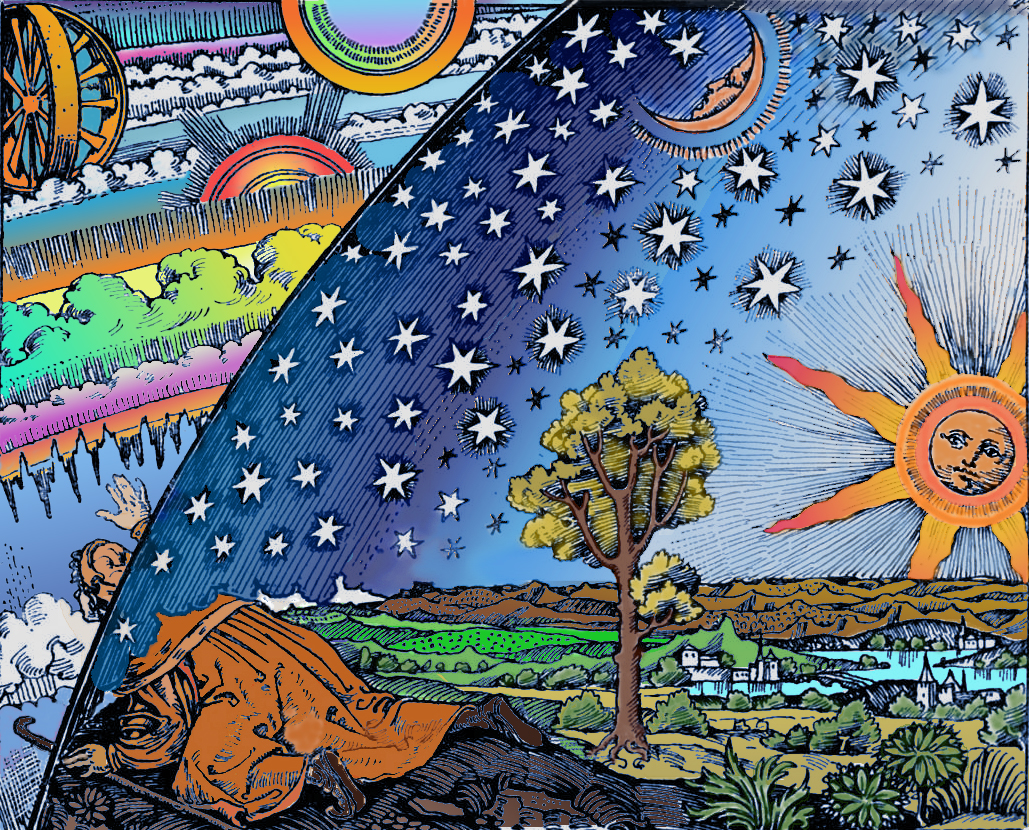
Then there is this woodcut I saw in some dictionary when I was a kid – I just couldn’t forget it, and it was another source of inspiration when writing Souls Walk in the Rain:
In a way the novel is also a celebration of reading literature. There is this mysterious female character, dedicated to all the (wonderful) book bloggers of the world – they truly are sirens of literature, luring people to read more books (and as a writer I consider them to be important allies because books have to compete for the attention of the people with so many things)…
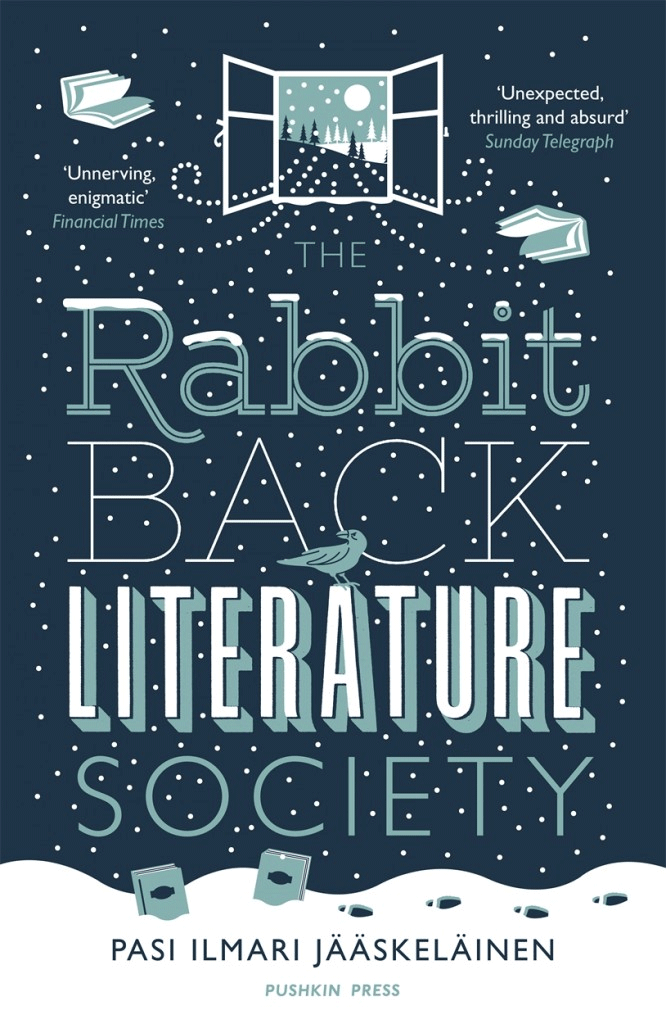
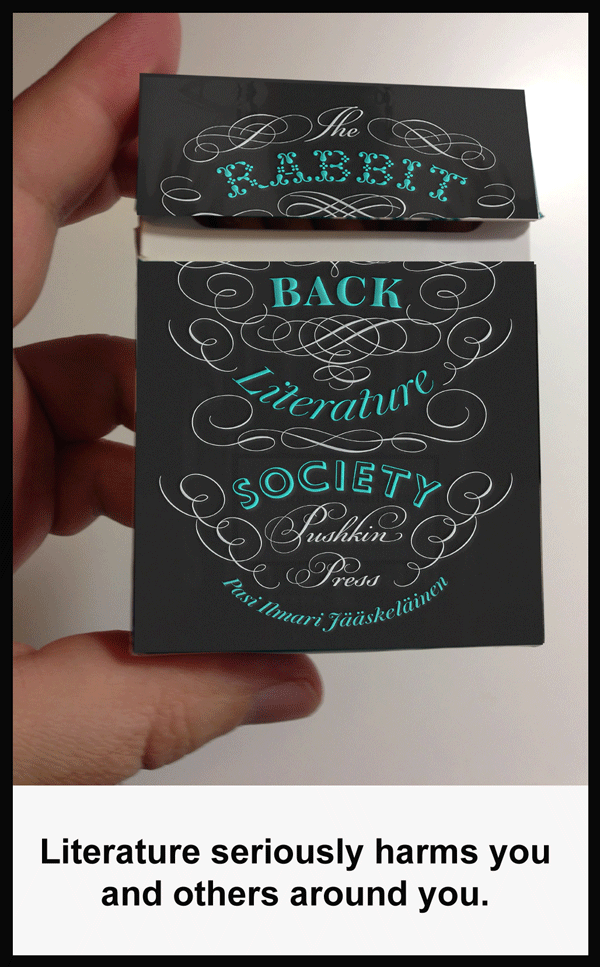
B-format cover of The Rabbit Back Literature Society
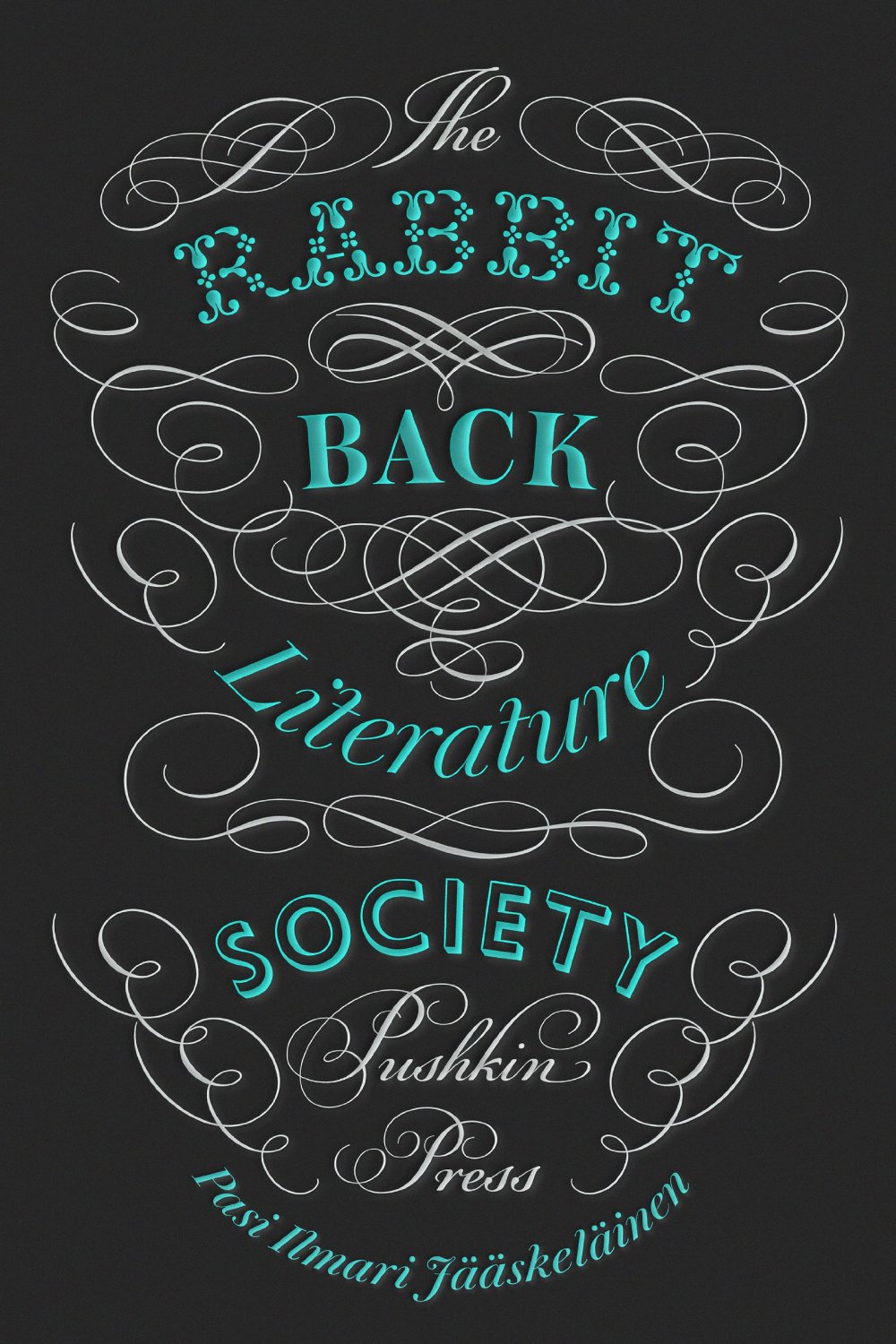
This is what the cover of The Rabbit Back Literature Society, published by Pushkin Press in 2013, looks like. I love it. I think it’s very stylish (as do many others), thanks to David Pearson. The B-format version of TRBLS will be published in September 2014 and it’ll have a new cover, designed by Nathan Burton. It’s quite different but as great as the first cover – I really love it (especially the little bird in it is absolutely delightful):
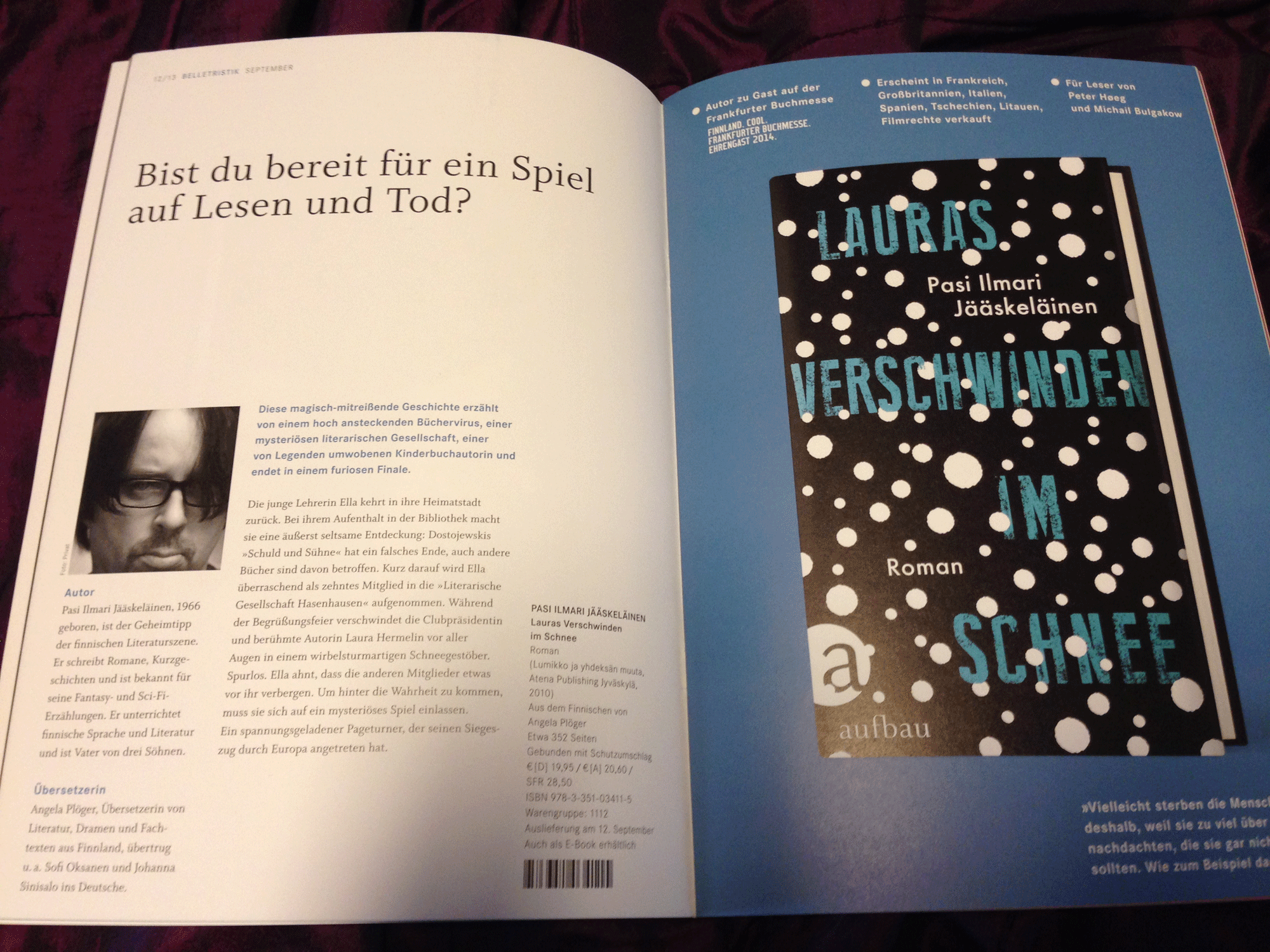
The German translation: LAURAS VERSCHWINDEN IM SCHNEE
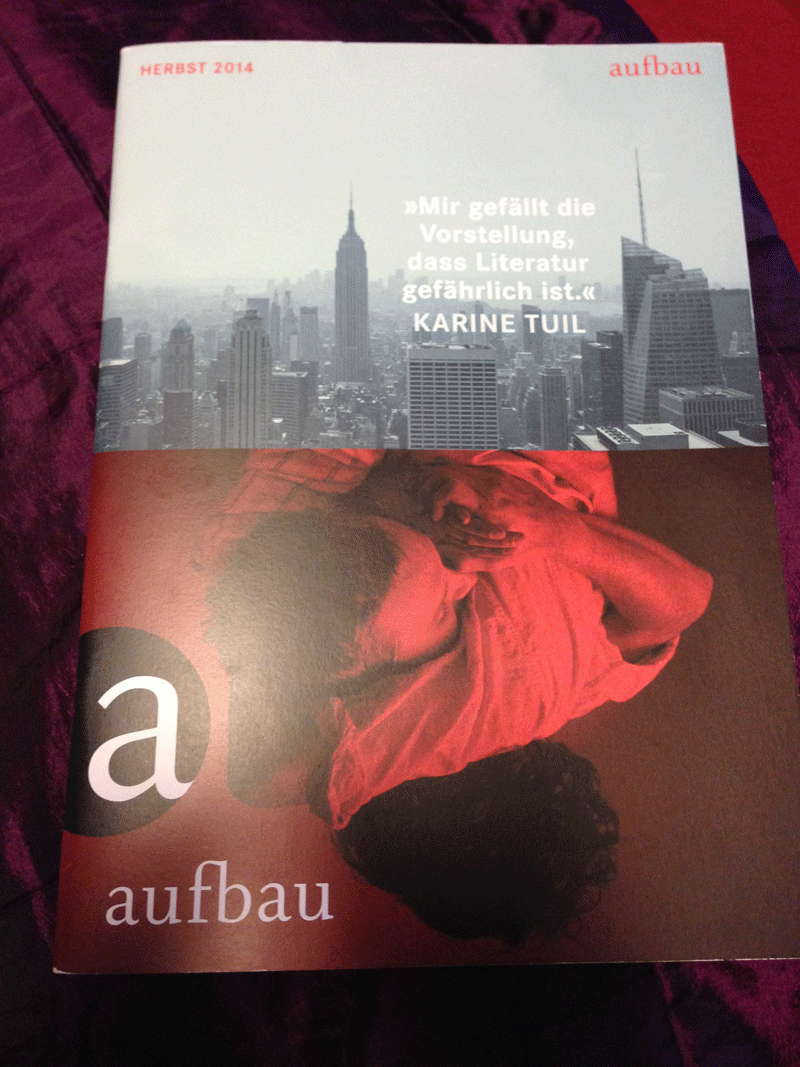
Our mailman brought something pleasant this morning: the new catalogue of my German publisher Aufbau Verlag. Pushkin Press published The Rabbit Back Literature Society in November 2013, and I suppose the German translation is the next one to become true in a form of a printed book – and in October I’m supposed to participate the Frankfurt Book Fair among several other Finnish writers (this year Finland is the guest of honour) and naturally LAURAS VERSCHWINDEN IM SCHNEE has to be available by then.
To be a Finnish writer…
As long as I only wrote for other Finns, there was no particular reason for me to identify myself as a Finnish writer. As a matter of fact, if anything, I propably saw myself as a non-typical Finnish writer because I have always loved horror, fantasy and science fiction and, more than anything else, the combination of realism and elements of different genres, and Finland has a long and still very strong tradition of literary realism – and that’s why writers like me have been somewhat outsiders in the field of Finnish literature – until these days, because times they’re changing… at least little by little. In 2000, Johanna Sinisalo’s first novel Not Before the Sundown won the Finlandia Prize, and this was the first (and so far the last) time a sci-fi or fantasy novel has gained that much recognition in Finland. To be more precise, Not Before the Sundown isn’t a pure scifi or fantasy novel but a mixture of realism and fantasy and thus more literary fiction with a flavour of fantasy than a genre novel. Anyway, this can be seen as a beginning of the rise of non-realistic literature in Finland.
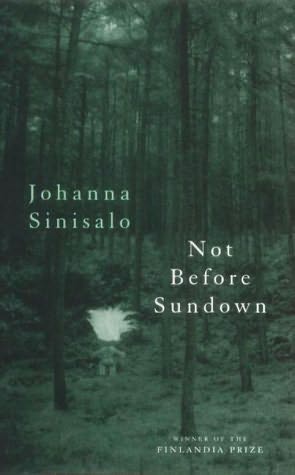
There are many different names for this kind of literature: magical realism, new weird, Finnish weird (or ”Suomikumma” – a term coined by Johanna Sinisalo), reaalifantasia (this term is coined by me)… There has been many debates about these terms over last years, but it’s important to understand that us writers (of reaalifantasia) do not see reaalifantasia as a new genre but as a liberating way to write ambitious novels without any genre boundaries. At least this is what it means to me: freedom to write literature using all of those elements that have been used in world literature since the first story ever was told.
As I said, this is not very Finnish way to do it. Not traditionally (except for Kalevala, our national epic which happens to be full of fantastical events). When it comes to the traditon of Finnish literature, us writers are supposed to write about Finnish Winter War, Continuation War, drinking too much Koskenkorva booze and becoming marginalized and shooting down one’s family… And then there is humour. Finnish readers love humoristic books. They even forgive fantastical elements of novels if they are used humoristically, as very popular Finnish writer Arto Paasilinna does. But if you want to write a serious book about Finnish reality and you use fantasy elements when doing it, you may be in trouble because most of the Finnish readers (and book buyers) are not ready for it. Not yet. (But as I mentioned, the times are changing. Year by year there are more writers like me – or like us (Johanna Sinisalo, Maarit Verronen, Tiina Raevaara, Juha-Pekka Koskinen, Anne Leinonen, just to name a few)- and more of those readers who like to have their books with a fantasy flavour.)
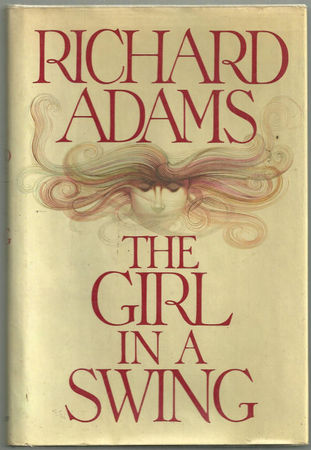
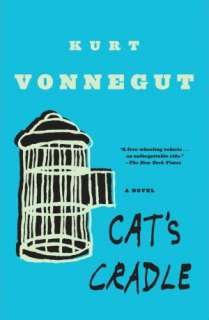
I suppose my foreign readers, however, consider my books (or my book, because so far only my first novel The Rabbit Back Literature Society has been translated into English) to be quite Finnish. And that’s okay. After all, I have lived in Finland all my life, surrounded by the Finnish culture. But I must say that I didn’t read much Finnish literature until I began to study it in university of Jyvaskyla at the age of 28. Before that, I read mainly British and American literature and to some extent Latin American and German literature: Graham Greene, Kurt Vonnegut (he is one of my all-time favourites!), Ray Bradbury, Peter Straub, Ira Levin, Arthur C. Clarke, Anne Rice, Isabel Allende, Arthur Conan Doyle, Stephen King, Clive Barker, Thomas Mann, John Updike, John Irving. Richard Adams, Philip Pullman, Robert Holdstock, H. P. Lovecraft… I would add Neil Gaiman to this list, because I find him to be some kind of kindred spirit of mine, but I didn’t find his novels and short stories until I had already published my first own stories.
So, I don’t know about being purely a Finnish writer – after all I grew up reading British and American literature. And television – more than anything I loved tv series like Sapphire & Steel (oh how I adored Joanna Lumley!), Star Trek, Twilight Zone, Six Billion Dollar Man… I guess my imagination is some kind of love child of Finnish mentality and the cultural influence of the English-speaking world.
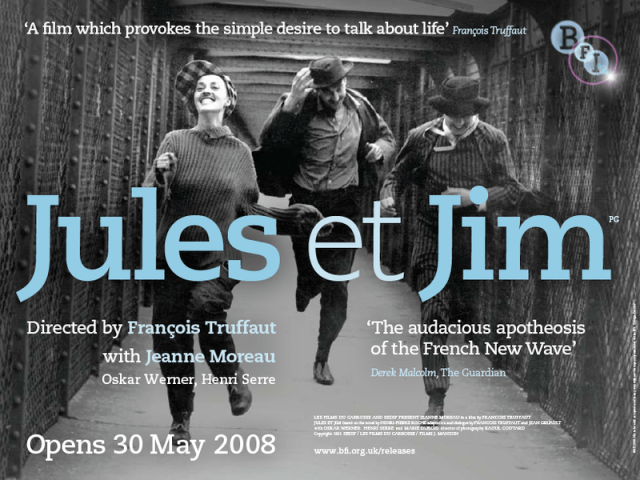
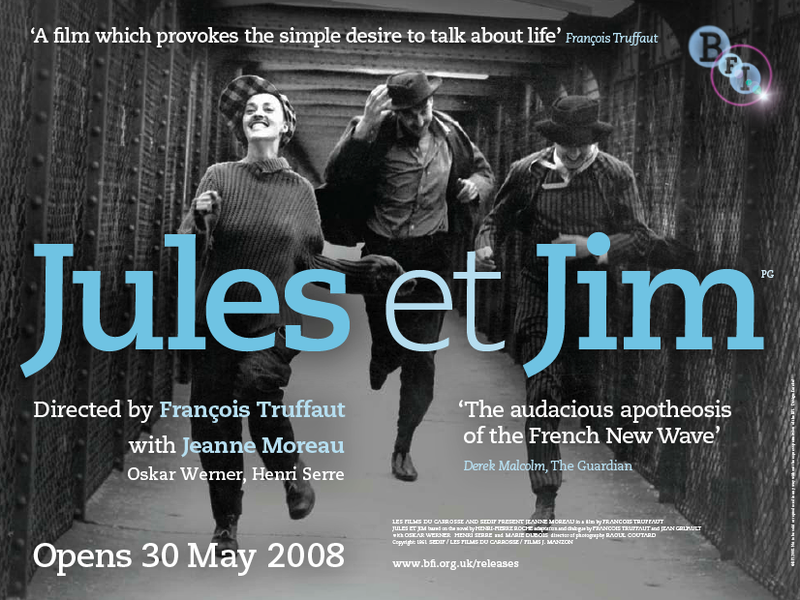
P.S. Also the French cinema had a great influence on my development as a storyteller. In my teens I loved Truffaut, especially Jules and Jim and I guess Truffaut is the reason why there almost always is complicated and a somewhat twisted love stories in my works.